Open sourcing ETE
No Special Equipment Required: Rapid and Large-Scale Production of Uniform Cell-Laden Capsules
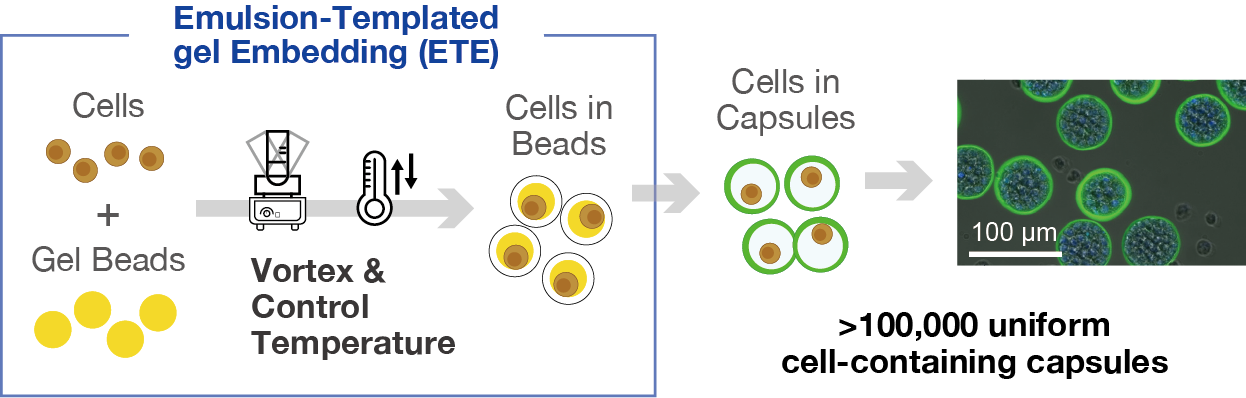
We have developed "Emulsion-Templated Gel Embedding (ETE)," a method that enables the mass production of uniform-sized, cell-laden hydrogel microcapsules using only standard laboratory equipment—without the need for microfluidic devices. This technology can significantly lower the barrier to introducing cell encapsulation in fields such as drug screening, 3D cell culture, and cell engineering.
What is Emulsion-Templated Gel Embedding (ETE)?
The ETE method creates uniform cell-laden capsules by using uniform-sized gelatin beads as templates to encapsulate cells, followed by the formation of a hydrogel shell. By combining temperature control and emulsion manipulation, it achieves uniform cell encapsulation without requiring specialized microfluidic devices. It is a method designed for researchers and technicians who want to perform cell encapsulation more simply and scalably.
No microfluidic devices required
Can be performed using standard laboratory equipment
Produces capsules of uniform size
Enables rapid, large-scale production (the scale is limited only by the number of core gelatin beads)
Supports 3D culture (cells can proliferate within the capsules to form three-dimensional cell populations)
Compatible with cell recovery
For Those Interested in Using This Technology
Implement it Yourself Using the Paper and Resources
Please refer to the published paper and related materials first. The principles, production process, and evaluation results of this method are detailed in the publication.
Emulsion-Templated Gel Embedding: A Microfluidics-Free Method for Scalable Cell Encapsulation in Hydrogel Microcapsules, Natsuko Otaki, Yuki Goda, Pooja Shukla, Hiromi Kirisako, Yuko Yamagata, Megumi Matsuo, Kazuki Hattori, Eiryo Kawakami, Sadao Ota. ACS Biomaterials Science & Engineering 2026.
DOI: https://doi.org/10.1021/acsbiomaterials.5c02129
Requesting Standard Materials
If you wish to receive standard materials for research purposes, please contact us with your affiliation, purpose of use, target cells, and desired timing. After confirming the details, intended use, and inventory status, we will guide you through the necessary contractual procedures (such as MTAs).
In-Depth Technical Investigation
For cases requiring deeper technical investigation—such as expansion to new applications, optimization of specific conditions, or application to specialized cell lines—please consult us regarding joint research or academic guidance frameworks. We will review your request to determine feasibility and potential collaboration.
Contact Information
Sadao Ota
Research Center for Advanced Science and Technology (RCAST), The University of Tokyo
E-mail: sadaotalab2@gmail.com
(Please use the subject line: "Regarding ETE")
Note
This page was created for the purpose of introducing research results. The availability and conditions for material provision, joint research, or academic guidance will be determined on a case-by-case basis depending on the purpose of use, contract terms, inventory status, and research framework.